
Leadership is historically judged on actions taken. In large organisational systems, this is often influenced by the expectations of others, perceived norms and boundaries, and a culture of obedience.
Thinking about developing the system, as well as the people in the system, makes sense. Historically, the development would have been a leadership programme or a coaching programme developing individuals in designated roles separate from the microsystems in which they work (professional silos) and the macro system (Regulation and Governments). The system described in the Corporate Plan and Culture Charter calls for something much more connected, more considered and more collaborative. This kind of leadership and change-making is concerned with the system as a whole, with all of its entanglements, history, and complexity.
The consolidation and change necessary to accelerate progress requires everyone to understand themselves and communicate about themselves in a different type of way. This kind of Personal Leadership has always mattered: connecting to values, understanding impact and being accountable. This has nothing to do with being a leader in a hierarchal sense and everything to do with leading yourself wherever you are in your life and in your work. Personal Leadership is for everyone, irrespective of age, experience, or position. It’s about leading yourself in your life. This concept will be facilitated for all members of the organisation in a truly ground-breaking, inclusive and in-depth start to the change desired.
Listen to Fiona MacNeill speaking about the concept of Personal Leadership.
The programme you are about to undertake is a consequence of that work. This toolbox supports your learning by supporting you to explore your Personal Leadership and Engage Others on your journey.
The toolbox encourages you to reflect in a positive way to support your resilience, the resilience of your colleagues and teams, and ultimately the resilience of the system as the new world emerges.
It feels critical to capture positive change, reflect on loss and define the Personal Leadership required for the emerging future. The programme poses the fundamental question, ‘What do I need to let go of and what do I need to learn?’
The simplicity of the question believes in the fact that the consideration of it needs space and that space needs to be held. The desire of this Personal Leadership Programme is that it creates that space whilst being absolutely mindful that it must not add additional stress in terms of time and expectations.
Listen to Shaun McNally, CEO, speaking about his hopes for the programme.
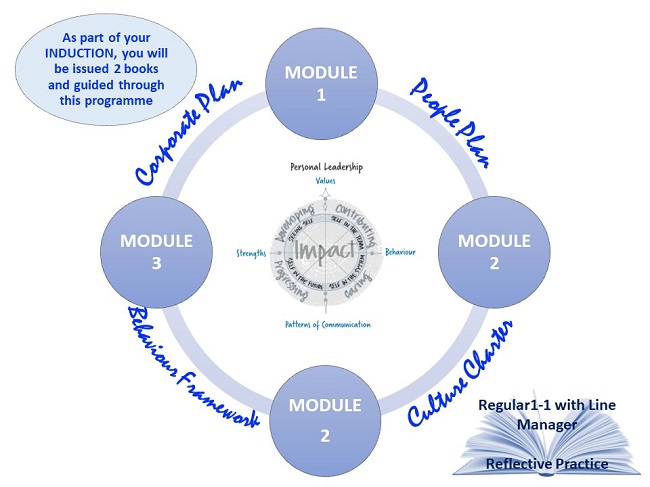
The programme has different tasks and activities over three modules, culminating in a Personal Development Plan that will inform your start at the Commission.
Personal Values and Responses to Change
Personal Communication and Communication Patterns
Strengths
The toolbox will walk you through the programme, providing underpinning knowledge and understanding. This will be developed through conversation and inquiry with your peers, line managers and the Learning and Development Team, who have volunteered to support a series of informal intentional conversations.
This whole process will be facilitated using the principles of Thinking Space.
MODULE OVERVIEW
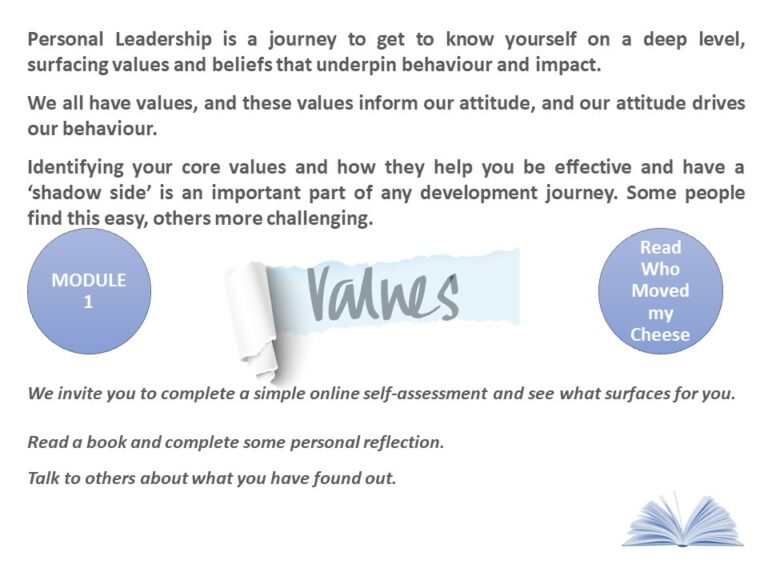

Personal Leadership is a journey to get to know yourself on a deep level, surfacing values and beliefs that underpin behaviour and impact. We all have values, and these values inform our attitude, and our attitude drives our behaviour. Identifying your core values and how they help you be effective and have a ‘shadow side’ is an important part of any development journey. Some people find this easy, others more challenging.
This idea is at the centre of personal development and growth: How do we learn about our impact, how do we ask for feedback, and how do we self-reflect? This selection of tools and frameworks will enable you to start to think about this in ways that can support and grow strengths and identify areas for personal change.
Discovering Your Values
Values drive behaviour. When I completed this self-assessment, my values came out as Honesty, Authenticity, Accountability, Friendship, and Commitment. These values show up in my behaviour every day. This means I struggle with people I perceive are not being straight with me, who are disingenuous and most of all, when I am faced with a lack of personal responsibility. In terms of my behaviour, I need to not jump to conclusions and remember to ask questions to discover more before I allow my honesty to be unhelpful! Equally, I am warm and open to building new relationships and will easily make commitments to support or help others.
We invite you to complete this simple online self-assessment and see what surfaces for you. When does each value make you feel good about yourself, and when does it get in the way?
https://personalvalu.es/
To contextualise this in the context of work. Please download and complete the activity.
Listen to Stephen Covey talking about Circle of Influence.
EMOTIONAL RESPONSES TO CHANGE
Before you work through this section, finish reading “Who Moved My Cheese”.
The Change Curve is a popular and powerful model used to understand the stages of personal transition. It helps you to think about how people might respond to change.
Experience, patterns of behaviour and current emotional state underpins how people will respond to change. So, understanding the differences in behaviours and emotional responses can help leaders and can help facilitators to respond appropriately by looking to get the best from people.
It’s important to remember that these are ‘normal’ and ‘natural’ responses to change.
Listen to Joshua Freedman talking about the emotions of change.
Reflective Practice

- How do the values you discovered relate to the Culture Charter?
- How will your values support you to contribute to the desired culture?
- What’s the shadow side of your values you will need to be mindful of?
- What have you learned about how you respond to change from the book and the two models presented?
- What do you need to let go of?
Now intentionally go and have a conversation with your Line Manager about what you have learned.